Fungi have been found growing in the remains of the Chernobyl Atomic Energy Station and surrounding areas. Their secret: use the radiation to grow!
After nearly two weeks without writing anything of substance due to overbearing exams, I'm finally back in action! To jump directly back into science, we'll be discussing a very weird property of certain fungi that have been found living in the Chernobyl nuclear reactor. They've not only figured out how to live with radiation levels many times that of the normal background, but they've also found a way to use it as an energy source for growth!

Showing posts with label Space. Show all posts
Showing posts with label Space. Show all posts
Friday, December 17, 2010


Sunday, November 28, 2010
What Happened Before the Big Bang? ... A Big Bang!
Posted by Alexandru Nicolae
 |
| Image Credit: NASA/ WMAP team. |
The current evidence states that the Big Bang that occurred 13.7 billion years ago gave rise to a universe that is constantly expanding, cooling, growing. As it does this it loses energy; at one point it will have lost all its energy resulting in a permanently cold and energy-less universe: a heat death.
Thursday, November 18, 2010
Antimatter Successfully Trapped At CERN.
Scientists at CERN (the European Organization for Nuclear Research) have succesfully trapped an antihydrogen atom.
Posted by Alexandru Nicolae
 |
| Image Credit: False colour image of Omega Nebula. NASA, ESA & J. Hester(ASU). |
Saturday, October 23, 2010
A Milestone in History.
... and now you're awake, in the world of the future. That's right, the world's first spaceport has officially opened in New Mexico, USA! This is so absolutely amazing that I'm going to try my hardest to explain this without falling out of my seat.
The entire venture is backed by British billionaire Richard Branson (if you can recall, he was discussing doing this years ago), and is designed to take space tourists to the very edges of our atmosphere, effectively into outer space. The privately owned company is called, prepare yourselves.... Virgin Galactic. The spaceport itself consists of a 3km runway and (so-far) two spacecraft: a mother-ship called White Knight 2 that will take a smaller ship, Spaceship 2, to proper altitude before launching it into the darkness and beauty of space.
The price of one flight is over $200,000 and it lasts for a whopping three hours. Oddly enough, that seems like a good deal to me. Inside the spacecraft you don't have to just sit and stare out at darkness, you can literally get out and float around in the spacecraft! Here are a few pictures from the official Virgin Galactic website (be sure to check out the website below for more multimedia and articles).
Now, I cannot possibly overstate the amount of sci-fi fantasies this will fulfill, not just to millionaires who can afford regular flights to space now but to many individuals who simply love pushing the frontiers of space exploration and human ingenuity. To think that in about 40 years since NASA's first test flights and overtly ambitious plans to get a man on the moon, we'd be one step closer to getting a much larger percentage of the population visiting space. Despite the fact that this isn't exactly the Millennium Falcon going into hyper drive, I still believe this moment is nothing short of a milestone in the history of our species. The sheer simplicity and reality of it all is far more beautiful than anything science fiction could have ever conceived for this moment.
To check out the latest news on this exciting new development, check out the Virgin Galactic website:
http://www.virgingalactic.com/
The entire venture is backed by British billionaire Richard Branson (if you can recall, he was discussing doing this years ago), and is designed to take space tourists to the very edges of our atmosphere, effectively into outer space. The privately owned company is called, prepare yourselves.... Virgin Galactic. The spaceport itself consists of a 3km runway and (so-far) two spacecraft: a mother-ship called White Knight 2 that will take a smaller ship, Spaceship 2, to proper altitude before launching it into the darkness and beauty of space.
 |
| Image Credit: Virgin Galactic. |
 |
| Image Credit: Virgin Galactic |
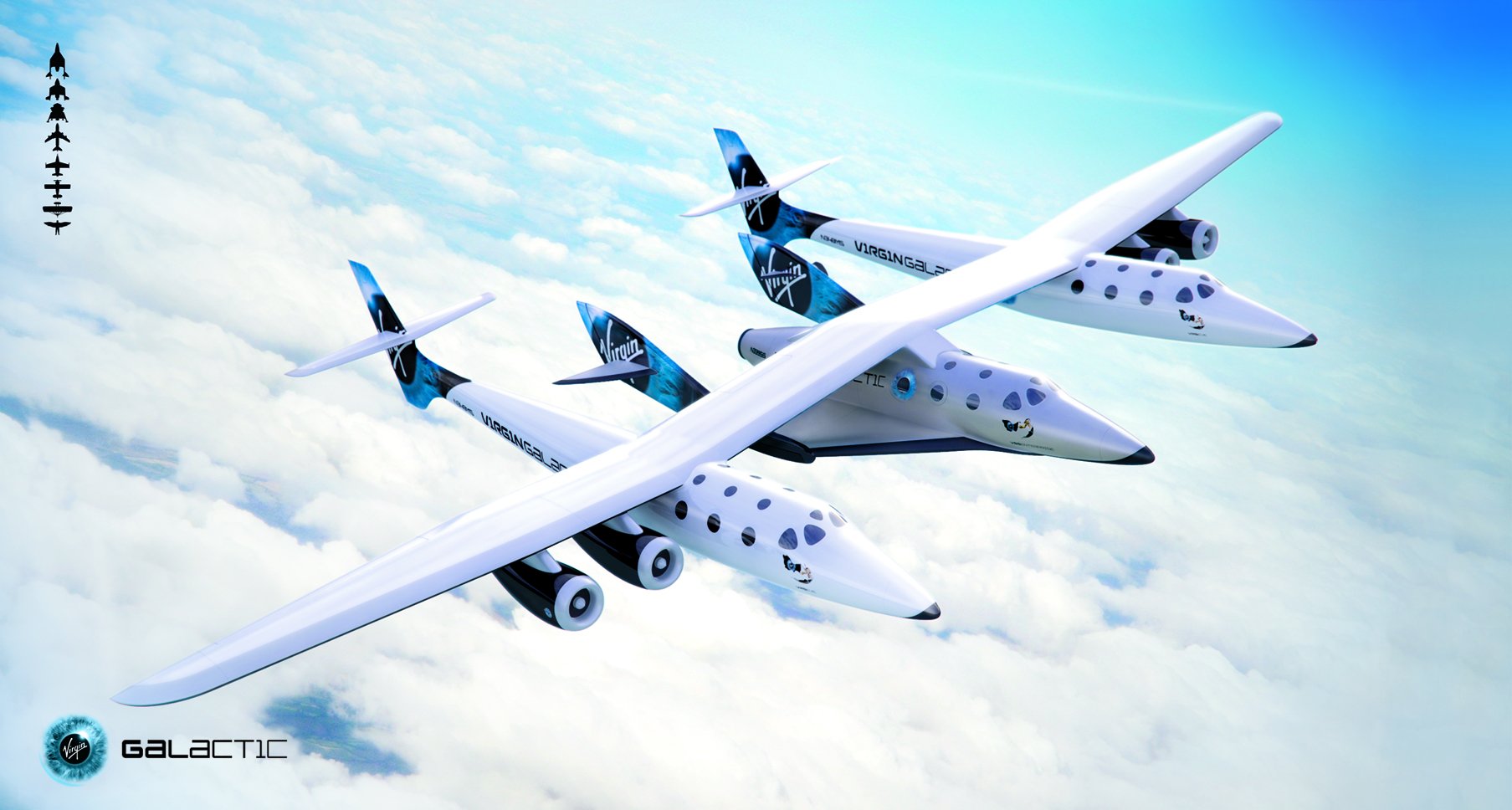
To check out the latest news on this exciting new development, check out the Virgin Galactic website:
http://www.virgingalactic.com/
Friday, October 22, 2010
Water on the moon!
Now this one is just simply awesome.
NASA recently published several research papers on an experiment they conducted in 2009. The experiment consisted of bombarding moon craters and detecting the debris that was released from the impact using LCROSS (the Lunar Crater Observation and Sensing Satellite). Spectrometers, radiometers, and several cameras were used to detect the presence of chemicals within the debris. What they found? water vapor, hydroxyl radicals (that nasty stuff that tends to damage human DNA), sulfur compounds, CO2, and various hydrocarbons. The satellite was even able to estimate the amount of water that was present in the ejection, nearly 155kg!
Now, before anyone jumps for joy and starts fantasizing about moon colonies and moon vacations to moon beaches, recall that the vast majority of that water is in the form of ice. Even when measured by LCROSS it was in the form of water vapour, not the familiar liquid we're used to. The NASA team conducting the experiment are saying however that around 11-12 gallons could be extracted from about 1 tonne of moon rock! That's a substantial amount, especially for visiting astronaughts.
It's interesting to note that frost-like water is not distributed equally but in "oases" across various parts of the moon, leading to the hypothesis that this is actually ancient water brought by asteroids or comets.
At that quantity of water though, one can't help but think of a moon resource-extraction colony supplying space travelers on their way to far off planets; to even think that in the next 10 years we could have dedicated structures operating on the moon makes one feel giddy. At worst the drill operations would simply break through the moon causing havoc for the people of earth, not unlike that god-awful remake of H.G. Wells' The Time Machine.
Here is the link to the various scientific papers discussing the findings:
http://www.sciencemag.org/cgi/content/abstract/330/6003/463
Subscribe to:
Posts (Atom)